Automatic pool cleaners are a practical investment for maintaining a clean swimming pool with minimal effort.
Pool cleaners generally last between 3 and 8 years.
The actual lifespan depends on the type of cleaner, how often it is used, the quality of water chemistry, and how well it is stored between cycles.
Among the three main categories, robotic models offer the widest potential lifespan, while pressure-side cleaners tend to wear out fastest.
Suction-side cleaners fall in the middle, with a typical range of 4 to 7 years.
Several controllable factors determine whether your cleaner reaches the lower or higher end of that range. Water chemistry, usage frequency, debris load, and exposure to sun and temperature extremes all play significant roles. By addressing these factors, you can avoid premature breakdowns and costly replacements.
Typical Lifespan by Cleaner Type
Pressure-side cleaners rely on a booster pump to operate, which places continuous mechanical stress on both the cleaner and the circulation system. Their average lifespan is 3 to 5 years. The bag filter, thrust jet, and wheel bearings are common wear points.
Suction-side cleaners are mechanically simpler and have fewer parts that can fail. With consistent care, they often last 4 to 7 years. The hose connections, flapper valves, and wheels tend to wear first.
Robotic pool cleaners have the widest lifespan range, from 3 to 8 years.
The main reasons for this variance are maintenance habits and storage conditions.
Drive tracks, brush rollers, motor seals, and battery cells are the components most prone to wear.
A well-maintained robotic unit can outlast both suction and pressure models, but neglect can shorten its life drastically.
One important note: a robotic cleaner that receives regular rinsing, proper storage, and balanced water chemistry can easily last 7 or 8 years, while the same model left in the sun with a clogged filter may fail in under three years. Maintenance makes the biggest difference with robotic cleaners.
What Shortens a Pool Cleaner’s Life
Water chemistry is the most common culprit behind premature failure.
High chlorine levels (above 3 ppm) degrade rubber tracks, brush bristles, and motor seals over time.
Low pH, below 7.2, makes the water corrosive and attacks metal fittings and O-rings.
High pH, above 7.8, causes calcium scaling that clogs filters, impellers, and moving joints.
Usage frequency also matters.
Running a cleaner daily during peak season puts more wear on brush rollers, drive tracks, and motor bearings than running it two or three times per week.
Most residential pools do not accumulate enough debris to require daily cleaning, and the extra run time shortens component life without improving water quality.
Ultraviolet radiation and extreme temperatures damage plastic and rubber parts.
Leaving the unit poolside in direct sun makes tracks brittle, cracks brush housings, and fades cable jackets. Dark plastic absorbs heat quickly, even in shaded areas.
In cold weather, rubber seals lose flexibility and battery capacity drops. Freezing temperatures can crack internal components.
Debris load matters more than most owners realize.
A cleaner operating in a larger or more debris-heavy environment than it was rated for will overfill its basket every cycle and strain the motor on every pass.
Buying a model slightly above the minimum spec for your pool’s size gives the motor and filter real headroom.
Maintenance Habits That Extend Life
The three most effective maintenance habits are rinsing the filter after every use, keeping water chemistry in the proper range, and storing the cleaner out of direct sun.
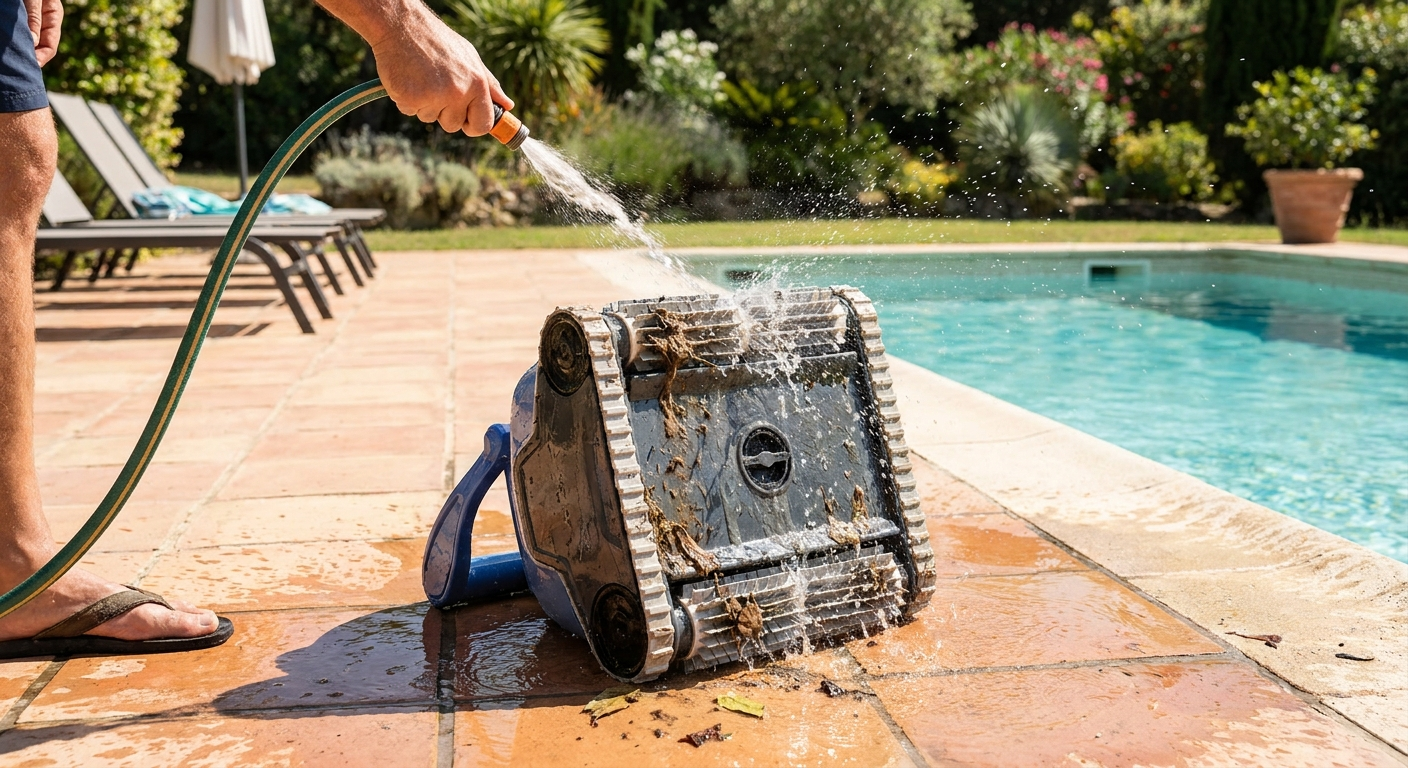
Two minutes with a garden hose clears chemical residue and fine debris before they degrade the mesh and seal material.
A partially clogged filter makes the motor work harder, so keeping it clean between cycles reduces strain on the most expensive component.
Chlorine should remain between 1 and 3 ppm, and pH between 7.4 and 7.6.
Checking these levels after heavy use, after rain, and at least twice a week during peak season prevents chemistry from drifting into harmful zones.
Balanced chemistry protects rubber, metal, and plastic across every cycle the cleaner runs.
Storing the unit indoors or in shade protects rubber and plastic from UV degradation.
For cordless robotic models, the battery should be stored at a partial charge of 40 to 60 percent if the cleaner will not be used for a month or more.
A fully discharged lithium battery loses capacity quickly, and a battery stored at 100 percent for weeks experiences accelerated cell aging.
Periodic inspections of moving parts are equally important.
Check wheel tubes, brushes, drive tracks, and hoses for signs of wear.
Replace worn bushings and belts before they cause secondary damage to the cleaner’s body or motor.
For robotic cleaners, inspect the power cord for fraying or damage that could pose a safety risk.
Adopting these practices is the most reliable way of extending pool cleaner lifespan. The difference between a unit that lasts four years and one that lasts eight is often just a few minutes of routine care after each cycle.
Signs Your Cleaner Needs Attention or Replacement
Most failures give warning signs before they become complete breakdowns.
If the cleaner consistently misses the same section of the pool on every cycle, the drive track or wheel may have lost grip.
A noticeable drop in suction between filter cleanings points to a worn seal or cracked hose.
Repeated stalling at the same spot indicates a drive motor or track tension issue.
If the unit runs for twenty to thirty minutes and then stops, battery degradation on a robotic model or motor overheating on any type is the likely cause.
Error codes that persist after rinsing the filter and restarting suggest a control board or motor fault.
When the cleaner is more than five years old and replacement parts are no longer stocked by the manufacturer, repair costs often exceed half the price of a new unit.
In those cases, replacing the cleaner is more economical than repairing it. However, for machines under four years old with a single faulty component, repair is usually worth it. A simple track or brush replacement can restore full performance and add years of service.
Practical Storage and Off-Season Care
When storing a pool cleaner for an extended period, drain all water from the unit and filter.
Thoroughly clean the filter basket and panels before inserting them back in place. Roll the cable or hose neatly without kinks.
Store the cleaner in a protected area out of direct sun, rain, and frost.
A temperature range of 5°C to 45°C (41°F to 113°F) is ideal.
For suction cleaners, breaking down hose sections and storing them straight prevents kinks and cracks that develop over time.
Avoid placing heavy objects on top of the hose or cleaner parts during storage, as this can cause deformation.
For robotic cleaners, storing the unit on a caddy or stable surface protects the wheels and brushes from unnecessary pressure.
By combining daily rinsing, balanced water chemistry, regular inspections, and proper off-season storage, you can maximize the return on your pool cleaner investment.
The cost of a few minutes of care each week is far lower than the expense of replacing a cleaner every two or three years.
About the Author