Time Flies—But How Fast?
Have you ever found yourself staring at a calendar, wondering how many weeks actually make up a year? It seems like a simple question, yet the answer is more intriguing than you might expect. Time, as we experience it, is fluid—weeks slip by, months come and go, and before you know it, another year has passed. Knowing how many weeks in a year isn’t just a trivial fact; it’s surprisingly useful for planning, budgeting, fitness goals, vacations, and even understanding the rhythm of your life.
Whether you’re a student organizing your semester, a professional tracking deadlines, or just someone curious about the calendar, understanding weeks in a year provides clarity. In this article, we’ll break down the exact number of weeks in a year, explore exceptions like leap years, and even dig into some quirky facts about our calendar system.
How Many Weeks in a Year: The Basics
At its core, a year is typically 365 days long. But what does that mean in terms of weeks?
-
A standard week has 7 days.
-
So, if you divide 365 days by 7, you get:
365÷7=52weeksand1day365 ÷ 7 = 52 weeks and 1 day
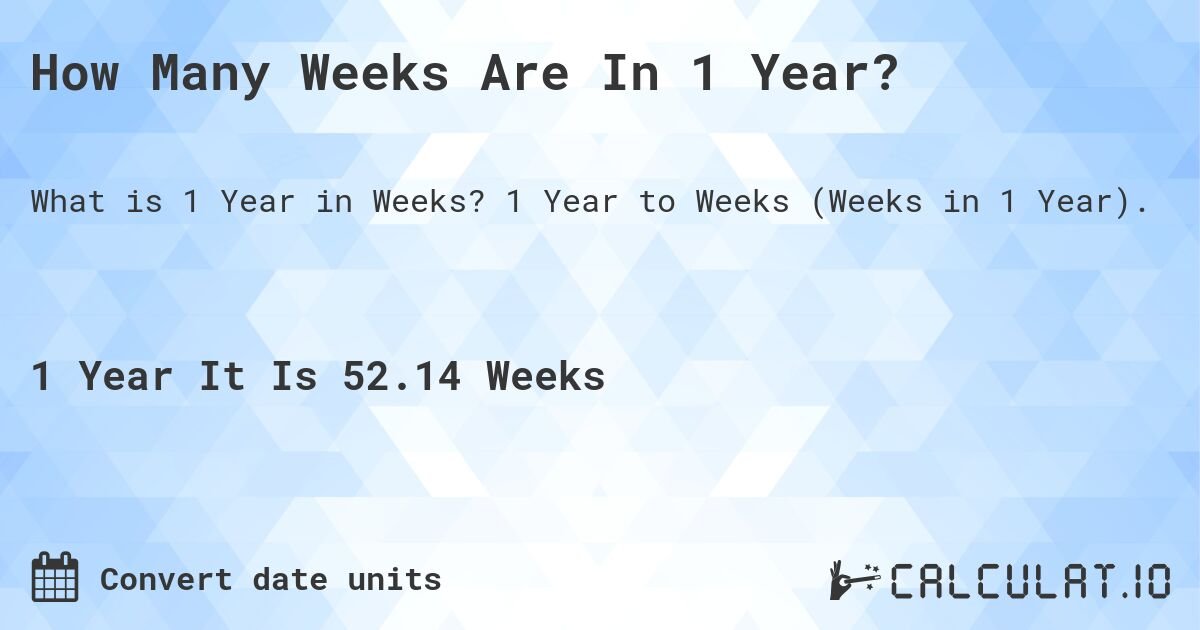
This tells us that a normal year contains 52 full weeks plus one extra day. That extra day is why the calendar shifts each year—for example, if January 1st is a Monday this year, next year it will be a Tuesday.
Leap Years and Their Impact
Every four years, we experience a leap year, which has 366 days instead of 365. Using the same calculation:
366÷7=52weeksand2days366 ÷ 7 = 52 weeks and 2 days
This means leap years have 52 full weeks and two extra days, subtly affecting our calendars. That’s why February 29th exists—it’s our way of correcting for the fact that Earth doesn’t orbit the sun in exactly 365 days.
Why Knowing Weeks in a Year Matters
Understanding the number of weeks in a year isn’t just a fun fact; it has practical applications:
-
Planning Projects and Deadlines: Businesses and students often work in weekly schedules, so knowing the total weeks helps with long-term planning.
-
Financial Planning: Many budgets and paychecks are structured around weekly or biweekly cycles.
-
Fitness Goals: Breaking yearly fitness objectives into weekly targets makes them more manageable.
-
Travel and Holidays: Counting weeks helps schedule vacations, seasonal trips, and long weekends.
Moreover, knowing the exact number of weeks allows you to reconcile your annual goals with your day-to-day tasks, giving you a better sense of time management.
Weeks vs. Months: A Common Confusion
Many people confuse weeks with months. Let’s clear it up:
-
There are 12 months in a year, but each month has 4–5 weeks depending on the month.
-
Short months like February have 4 weeks, while longer months like July have 4 weeks and 3 days.
-
This irregularity is why calculating weeks can sometimes feel tricky.
Here’s a simple table to visualize weeks in each month:
| Month | Days | Weeks (Approx.) |
|---|---|---|
| January | 31 | 4 weeks + 3 days |
| February | 28 | 4 weeks |
| March | 31 | 4 weeks + 3 days |
| April | 30 | 4 weeks + 2 days |
| May | 31 | 4 weeks + 3 days |
| June | 30 | 4 weeks + 2 days |
| July | 31 | 4 weeks + 3 days |
| August | 31 | 4 weeks + 3 days |
| September | 30 | 4 weeks + 2 days |
| October | 31 | 4 weeks + 3 days |
| November | 30 | 4 weeks + 2 days |
| December | 31 | 4 weeks + 3 days |
This table makes it clear: weeks in a year add up to 52 plus 1 or 2 extra days, depending on whether it’s a leap year.
Interesting Facts About Weeks
Weeks aren’t just about counting—they have history and cultural significance:
-
The 7-Day Week Origin: The 7-day week dates back to ancient Babylon, linked to the seven celestial bodies known at the time.
-
Global Differences: Not all countries start the week on Monday. For example, in the United States, Sunday is considered the first day of the week.
-
Business vs. Calendar Weeks: A “business week” usually refers to Monday through Friday, while a calendar week includes the weekend.
-
ISO Week Numbering: The ISO standard defines the first week of the year as the one containing the first Thursday.
Understanding these differences is helpful if you work internationally or need precise week calculations.
How to Calculate Weeks in Any Year
Here’s a step-by-step method for calculating the number of weeks:
-
Identify the total number of days in the year – 365 for normal years, 366 for leap years.
-
Divide by 7, since a week has 7 days.
-
Note the remainder, which tells you extra days beyond full weeks.
-
Adjust planning for those extra days—they often determine holiday shifts or calendar alignment.
For example:
-
2023: 365 ÷ 7 = 52 weeks + 1 day
-
2024 (leap year): 366 ÷ 7 = 52 weeks + 2 days
Breaking Down the Year: Weeks in Quarters
Many professionals and businesses plan by quarters. Knowing weeks in a quarter is essential:
| Quarter | Months | Approx. Weeks |
|---|---|---|
| Q1 | January – March | 13 weeks |
| Q2 | April – June | 13 weeks |
| Q3 | July – September | 13 weeks |
| Q4 | October – December | 13 weeks |
Notice the symmetry? 52 weeks divided by 4 quarters = 13 weeks per quarter, making project and financial planning easier.
Tips for Using Weeks in Year Planning
Here are some practical tips to leverage weeks effectively:
-
Goal Setting: Break annual goals into 52 weekly milestones for better tracking.
-
Budgeting: Plan your finances weekly to avoid surprises.
-
Fitness: Set weekly exercise or diet targets instead of monthly ones—they’re more actionable.
-
Travel: Use weekly breakdowns to manage vacations, school breaks, and work schedules.
Additionally, if you’re using project management tools, most allow you to set weekly intervals—this aligns perfectly with the natural rhythm of 52 weeks in a year.
Fun Trivia About Weeks
-
There are 52 Sundays in a non-leap year, but some years may have 53 Sundays due to the extra day.
-
Some cultures historically used 10-day weeks or 5-day weeks, showing that the 7-day week isn’t universal.
-
Businesses often offer weekly reports, reflecting the 52-week rhythm of the year.
Common Misconceptions About Weeks
-
“A year has exactly 52 weeks” – Not true, because of the extra 1 or 2 days.
-
“Leap years add a whole extra week” – Actually, only 1 extra day is added every four years, not a full week.
-
“Every month has four weeks” – Some months spill over a few extra days, affecting schedules.
Understanding these misconceptions can help avoid scheduling errors, especially for business and school calendars.
Conclusion: Time Counts, Weeks Matter
So, how many weeks in a year? The simple answer is 52 full weeks, with 1 extra day in a regular year and 2 extra days in a leap year. But beyond the numbers, weeks are the rhythm of our lives. They structure our work, our rest, our plans, and even our celebrations.
By breaking your year into weeks, you can plan more effectively, set achievable goals, and appreciate how quickly time passes. Whether you’re organizing projects, setting fitness goals, or just satisfying your curiosity, understanding weeks gives you a small but powerful insight into time itself.
Now that you know the answer, why not take a moment to look at your calendar? Count your weeks, plan your priorities, and see just how much you can achieve in 52 weeks. Share this knowledge, comment with your favorite planning tips, or start your own weekly challenge—because every week really does count.
About the Author